Sensory art - what does it mean?
Sensoplasty, i.e. sensory art, combines artistic activity with stimulation, and therefore, the development of the child's senses - touch, sight, smell, hearing and taste. This is an effective method of sensory integration exercises that is fully developed by the age of 7. Many young children have problems with the proper functioning of the sensory sphere due to increased sensitivity to stimuli coming from the environment. The modern world does not promote development on different sensory levels. A child's lifestyle is often saturated with time spent in front of screens of various devices, and therefore spending it indoors in a sitting position. Then the number of sensory experiences is limited, which leads to sensory integration problems.
Sensory art is a cognitive method that occurs through fun enjoyment. The materials used in it can be any that work with will stimulate the senses and be safe for children depending on their age. These can be such food products as: rice, flour, pasta, water, oil, seeds and many others. Sensory play also uses more specialized products such as texture sheets, pom-poms, finger paints, styrofoam and holographic foil, kinetic sand, styrofoam balls, plasticine or clay. It is important that the means we use are diverse in aggregate state, texture, density, plasticity, etc. Sensory art brings many benefits for children's cognitive development.
The developmental benefits of sensory art.
"Art is not a mirror that can support society, but a hammer with which it can be shaped."
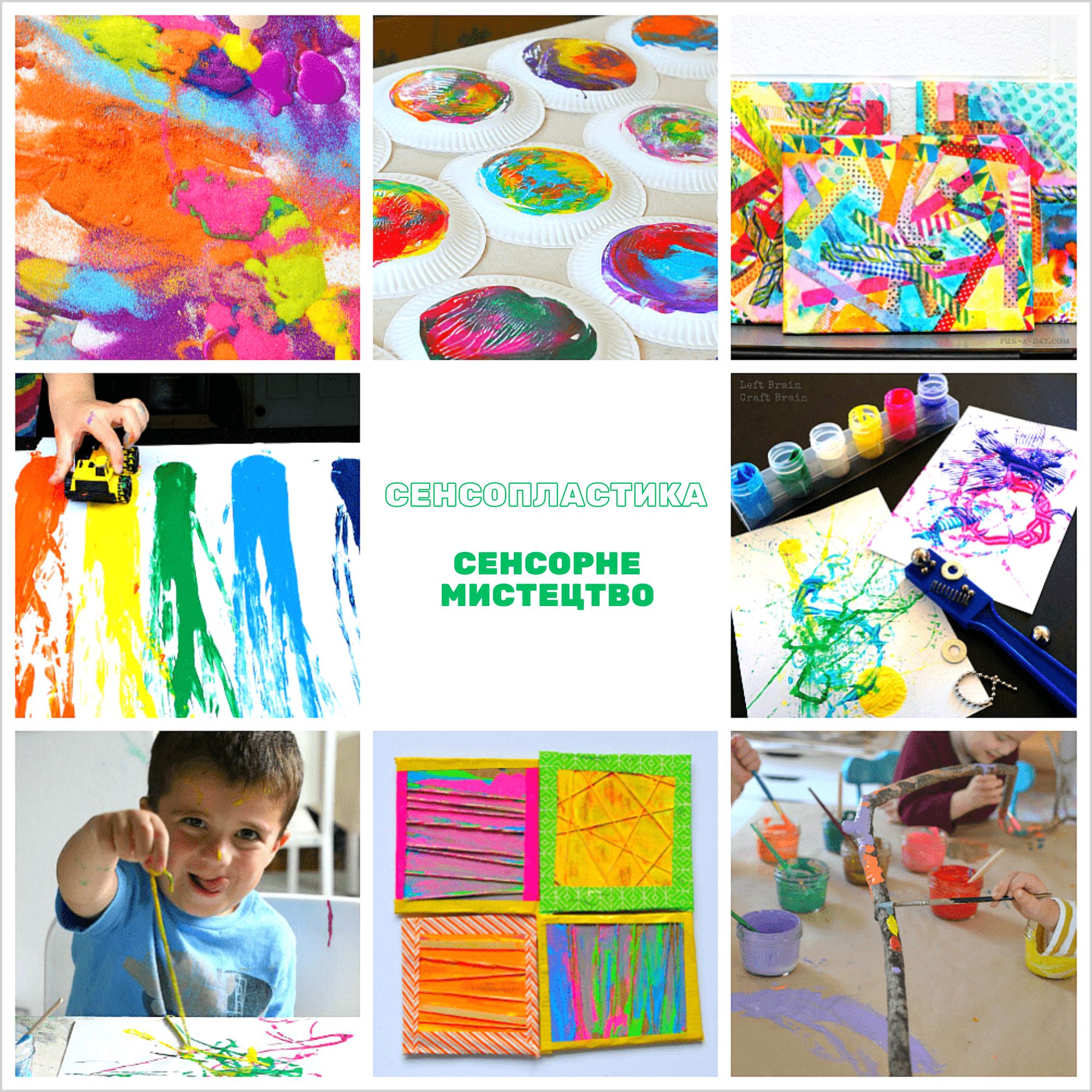
Sensory art gives children many advantages for development in various directions.
The activities involved in the creation of sensory artworks are a fantastic pleasure that is combined with the formation of sensory reception, emotional, manual, creative, motor and social spheres. Sensoplasty stimulates curiosity, as well as the natural need to explore the world, supports the formation of awareness of the body and its location in space, allows experimentation and learning about new phenomena. Children with disorders of sensory integration are often restless, tearful, clumsy, poorly coordinated, avoid social contacts, have difficulty eating and falling asleep. Disorders of sensory integration lead to many problems and difficulties in functioning in later adult life. Sensoplasty activates all sense organs, positively influencing their development. Knowing, comparing, smelling, touching and tasting, the child discovers the surrounding reality and the stimuli it creates. Artistic and sensoplastic activity is also a form of relaxation, release of creativity and energy, has a positive effect on mood and well-being, providing emotional comfort and self-satisfaction from the work performed. Multisensory stimulation supports the creation of connections between neurons - this is extremely important for brain development in the first years of life. The more they are produced in childhood, the more effective and confident an adult will be. providing emotional comfort and self-satisfaction with the work performed. Multisensory stimulation supports the creation of connections between neurons - this is extremely important for brain development in the first years of life. The more they are produced in childhood, the more effective and confident an adult will be. providing emotional comfort and self-satisfaction with the work performed. Multisensory stimulation supports the creation of connections between neurons - this is extremely important for brain development in the first years of life. The more they are produced in childhood, the more effective and confident an adult will be.

What are sensory arts lessons?
Sensory art classes can be held both in kindergartens, schools, and at home. They are designed for any age group. The selected materials and aids should be age-appropriate and include a range of products that are completely safe. During classes, participants play with various masses, products, substances, materials that are easily recycled, etc. They have the opportunity to experiment with liquids, loose, soft and solid products, to touch textures, shapes, aggregate state... Children have the opportunity to creatively get dirty, for example, while painting their fingers, which will bring them great pleasure. Participants can mix, roll, sculpt, dip, pour, smell and touch, whatever their form of self-expression tells them.
Examples of sensoplastic activity.
Before starting classes with sensory art, remember that the child's clothes must be prepared for the fact that they can get dirty. It is worth arming yourself with, for example, protective aprons.
The first of our suggestions for sensory activities is playing with sand. Children's hands are the most important "tool" in the activity. Their tasks are to perform certain actions with sand, such as pouring, kneading, sifting or modeling. Kinetic sand is needed
for creating castles, cupcakes or other structures that will encourage children's creativity. It consists of grains of ordinary sand with the addition of a polymer that is safe for health. With its help, children have the opportunity to perform any shapes, thus training fine motor skills, developing the ability of spatial thinking and stimulating imagination.
Another game we offer is a sensual journey for the feet. It consists in preparing the so-called sensory path. The marked route can be divided into separate tiles, on which there will be various objects and substances that provide sensory stimuli. Examples are pieces of cloth, felt, feathers, down, groats, rice, tissue paper, or special textured square rugs. The children's task is to walk barefoot along the prepared sensory track. Thanks to the variety of colors, the sight is stimulated, the variety of sensations of the path stimulates the touch, and the sounds produced by the materials used during walking stimulate the hearing.
To develop musical and artistic sensibility, children can draw music on canvas. It is necessary to spread a large canvas for a group of participants on a pre-fixed surface. Each of them should have its own place, along with the appropriate tools, such as a palette for mixing colors, paints, brushes and a cup of water. Children can also paint with their hands, spatulas or sponges. In the exercise, we do not impose the topic of the work, the task of the participants is to color over what they heard, express expressions, fantasies, received sound stimuli, let them get excited, experiment with colors, forms of expression, let them create their own abstractions. In conclusion, it is worth looking together at the diversity of the participants' works and talking about the emotions that accompany them.
To perform tasks that stimulate the sense of smell, we suggest preparing cotton balls, flavorings, food products with an intense smell, for example, cinnamon, citrus, onion, pepper, etc. Participants are divided into pairs and sit opposite each other. The task is to put moistened cotton discs or pieces of food under the nose of the interlocutor (with closed eyes) so that he can guess what it is by smell. The same goes for the degustation, where your couple is served food samples prepared in a cup. The pairs change, first one guesses one child, after a moment the second. Fun gives a lot of laughter and joy, but above all, it provides a sensory experience and promotes the development of social relationships.
Sensory art at home.
Classes in the field of sensoplasty can be held at home. Even helping in the kitchen or cooking together gives the child many sensory experiences. A good example that stimulates the senses is making dumplings, kneading dough, tasting pies, smelling aromas, mixing substances or forming cookies. For creative activities, you can make your own salty dough to create your own spatial works, make paints, for example, from multi-colored jelly and paint with your fingers, make picture sandwiches or create works of art from pasta, rice, flour, salt and sugar.
The time spent together strengthens the parent-child bond, brings joy, satisfaction and a good emotional state to both the child and the adult. Celebrate moments together by having fun with sensory art.