Time management is a valuable skill
Planned and organized learning is one of the conditions for achieving success in school and forming the right motivation for work. Children learn through imitation and modeling, but to make learning more than just a chore, they need a role model they can relate to.
Observing the work of his parents, brothers and sisters, teachers, participating in joint activities, trying different methods - the child learns to intelligently organize his studies, manage time, prevent distractions and fight stress.
Content
How to teach a child to plan?
How can I help my child get organized?
What should a child know to do homework more effectively?
How to teach a child to plan?
Planning is important because:
increases learning efficiency,
facilitates "control" of time,
allows you to find time both for duties and for rest,
increases the feeling of freedom and control,
it gives a chance for success and thereby strengthens the formation of internal motivation for effort.
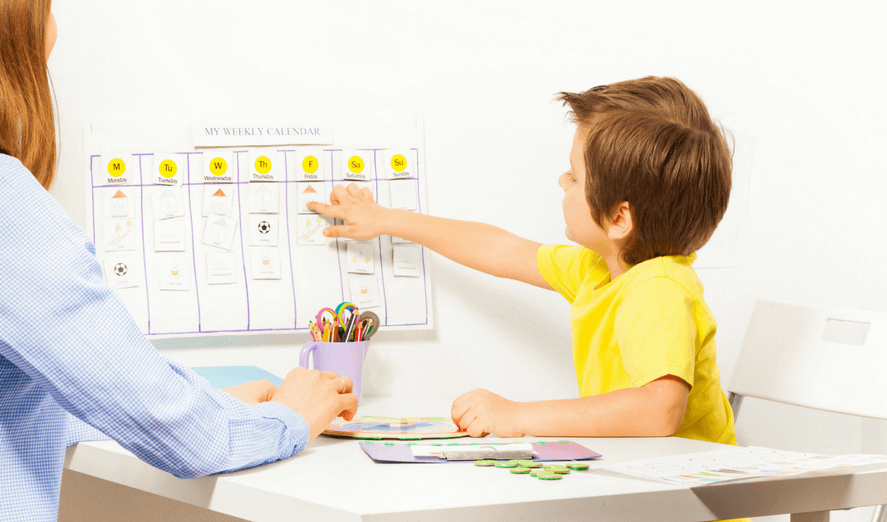
The study plan must have a "concrete" form - it must be drawn up on a sheet of paper (for older children, it can be saved in a calendar or phone). Let's teach children to make a weekly plan (but on one page) and a daily plan (for example, on smaller pieces of paper).
The weekly plan is drawn up at the end of the week, at first we accompany the child in drawing it up. We compile it on the basis of the lesson plan, note which tests will be in the near future, which additional activities (reading, presentation, art work) need to be performed, which additional classes the child participates in.
Plans for the day are made after returning from school. We take into account:
that the homework was assigned for a certain day (written and oral tasks) and when,
the procedure for performing the work and the time we can allocate for it,
tasks that require the help of parents,
time to relax
When creating plans, you should use colored markers, use conditional designations, cross out what has already been done.
How can I help my child get organized?
We begin to "learn" to organize ourselves by providing information that makes homework easier. This can be done in the form of a conversation, using a multimedia program or placing "reminders" (advice in the form of short slogans) in the room. The next step is to track whether the child uses our hints, whether he remembers the rules and tries to apply them. It is also important to strengthen the child's efforts, gradually increasing his independence.
What should a child know to do homework more effectively?
REST AFTER SCHOOL - after returning from school, it is important to take a short rest and do something that the child likes, for example, a short walk, drawing, building with blocks, listening to favorite songs, reading a book, etc. We avoid watching TV or playing computer games.
TIME TO DO LESSONS - the best time for studying is the morning and later during the day (9.00-11.00, 16.00-20.00), the worst in the evening (after 21.00) - the brain does not absorb information at this time. It is worth taking a break between eating a large meal and studying (after eating, concentration weakens because the body is involved in digestion), do not plan to study immediately before exciting events (match, competition, concert) - emotions will dissipate.
USING AND RESPONDING TO REMINDERS - If possible, start homework at a set time. It's helpful to set up alerts to remind you when it's time to do your homework (eg password, phone ringing).
REMEMBER BREAKS - after 30-45 minutes you should take a small 5-10 minute break for short gymnastics, play with the dog, drink water, etc.
PLANNING - we start homework with the weekly plan and the work plan for the day.
A GOOD PLACE TO STUDY - make sure that there are as few distractions as possible in the room where the child works - turn off the TV, put the phone in a drawer, only what is needed for work should be on the table. We also take care of good lighting (white light is better), ventilation of the room, correct body position (we encourage the child to do lessons at the desk or sitting on the floor, but avoid lying on the bed - when we are too comfortable, we get lazy and fall asleep).
In the case of children who have trouble getting things started - if the room is messy, don't ask for it to be cleaned before class as it delays class and wastes energy. It is better to "cover" scattered things with a blanket and ask the child to clean them up after school.
PAY ATTENTION - The fewer distractions, the better your attention. Some children, however, find it useful to focus their attention on calm music that "muffles" other sounds from the environment, or on the opportunity to release tension with movement (for example, a child sits on a large ball while learning or holds a squishy in it) hands).
Concentration is also facilitated by changing the position of the body or the place of study (for example, each subject can be studied in a different room - bathroom, kitchen). With a pronounced tendency to think, we use the orange dot method - above the desk, in plain sight, we hang a colored dot drawn on a white sheet (yellow, orange) and agree with the child that if he looks at the dot, it means that he is not studying - then click fingers and say "focus" to yourself.
It is also very important to develop the habit of completing tasks - we finish one task before starting the next, and we divide longer or more difficult tasks into stages.
ASK FOR HELP - the child should know that if the task is too difficult, he can ask someone for help, for example, a parent or write a question on a piece of paper and show it to the teacher in the next lesson. Parents can help with homework, but should not do it for the child; they can first help plan the work, check its correctness, explain more complex sentences, control the pace of the work, the level of concentration on the actions being performed (for example, check the room every few minutes and check if the child is working).
PACKING THE BACKPACK - we finish the homework, pack the backpack for the next day, the child independently prepares books, notebooks, accessories, and the parents check whether they have forgotten anything.
After completing the homework, there should be time to do what the child likes and what he was waiting for (ride a bike, watch a cartoon or a movie, play on the computer).